Translate

Search This Blog

2013/05/25

Doors Open - York Museum

This weekend is Doors Open in Toronto. We decided to go to a couple places today.
One of them was York Museum which is in Centennial Recreation Centre. It's only one room and it's usually open only by appointment.

It may be only one room but there are a lot of things in there. There were only a couple of things in there from the Victorian Era, but it was really cool to finally go in!

Here are the things that I found interesting:
This is what a telephone operator would use to connect calls.

Here is an old Singer sewing machine.

This was used to wring out clothes after you washed them.

This is a kerosene stove.

A box for skates.

An old shopping guide.
Look at the emergency telephone numbers.

A camera.

This shelf had a hot plate, meat grinder, bottle warmer and a toaster.

Pharmacists and doctors became more available to people as neighbourhoods developed.
Here's a sign from one of the pharmacists. On the shelf above it, you can see a pair of glasses from the Victorian era.

This soup taureen was from the Victorian era.

You could keep hot water or coffee in these containers.

Here's a dairy can. In the 1890s eight gallons of milk cost 60 to 85 cents!

These are paintings of Franklin Jackes and his wife. Franklin Jackes was the first Reeve of the Township of York in 1850, when the Township of York had its own local government.

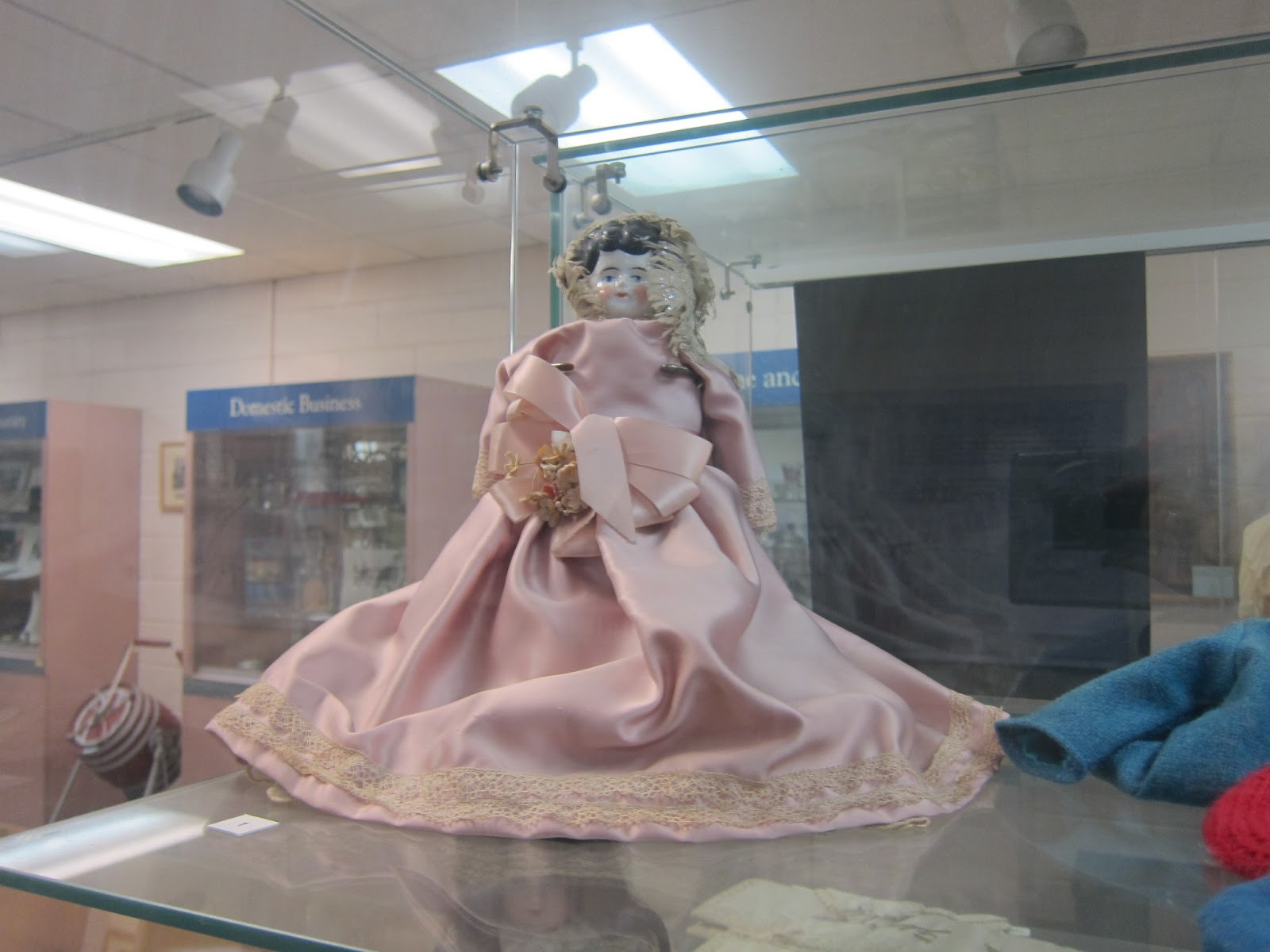
This china doll with a leather body is from 1874.

This is a doll made out of corn husk.


I guess I need to figure out the difference between the "Township of York", the "Town of York" and the "County of York". It seems a little confusing to me. When I figure it out, I'll do another blog post about it.

2013/05/24

Victoria Day at Montgomery's Inn

Since we're learning all about the Victorian Era, we just HAD to do something special for Victoria Day! So, we went to Montgomery's Inn for their Victorian Tea followed by a tour of the Inn. 

We had tea, cookies in the shape of a crown and cake. 

Montgomery's Inn was run by Thomas Montgomery and his wife Margaret. They were both Irish immigrants. The Inn was built in 1830 and they added on over the years.

Margaret Montgomery was probably the one who would cook and do things like make soap and candles and deal with the lodgers. They had servants who would have helped.

In the bar room they would serve alcohol.
There was a cage around the bar.

The chairs would sometimes be broken from bar fights.

There would probably have been a little community notice board.

They would also have a more formal dining area for the travellers who were willing to pay extra.

This is a sitting area where the family could sew or read. The lamp used whale oil and doesn't cast a shadow so it was good for sewing.

This was the original sign that was outside of Montgomery's Inn.

This Grandfather clock was probably original to Montgomery's Inn. 

The Montgomery's children probably had the room next to the parent's bedroom.

Canopy beds were popular in the Victorian Era.

This room was one of the lodging rooms.

This was the assembly room. People would get together and have meetings in this room.
(By the way, Montgomery's Inn wasn't the one that was involved in the 1837 Toronto Rebellion... That was Montgomery's Tavern at Yonge & Eglinton. The government burned it down after the rebellion.)

This sign shows that Montgomery was an Orange Man. There are Three Fs on the triangle which stand for "Faith, Fellowship and Friendship". The Orange Lodge met there.

There is a "Speaker's Box" in the assembly room.
They still use this room as a Community Room today.

Here is what the lodgers' area might have looked like.

They also had more private rooms that would have been used by families who were traveling together.

Here is another picture of the fire.
They had really yummy cookies!

It was a great tour and I hope to go again soon!

Spadina House and Gardens

We're trying to visit all of the City of Toronto Museums.
On May 19th, we went to Spadina House.

James Austin was an apprentice of William Lyon Mackenzie before the 1837 rebellion! Even though James Austin had his own print shop at the time of the rebellion, he went to the United States because people knew he was associated with Mackenzie. When he came back to Canada in 1843 he had enough money to start a grocery store with a partner. They were so successful that they were able to start lending money to others within a few years.

James Austin bought the land that Spadina House is on in 1886. 
Three generations of Austins lived in Spadina House.
The Austin family donated the house to the City of Toronto and it's now a museum. 


There is some archeological excavations in the basement of Spadina House and you can still see where they dug. They found out more of the history of the property. It was owned by the Baldwins before.

Spadina House is set up as it was in the 1920s.
At the front door they have 2 wolves. Here's a picture of one of them. Don't you think it's strange?

They had an inside garden!
There was a trap door so that the servants could go into the room to take care of the plants without being seen.  (I wonder if they'll open up those secret passages for tours.)


Here's a picture of the dining room. Do you see the curtain at the right? The servants would put the food out onto the table from behind the curtain. That way, you would only see their hands. 

I liked this painting the most because it shows Mary Austin holding a music score. She used to play organ for her church before she got married, but back then it wasn't 'proper' for a rich, married woman to play for a church.

This is a picture of the Drawing Room.

The 1888 Steinway piano was a wedding gift for Mary Austin from her husband.  

Mom tried to get a close up picture of the gas light chandelier or would you call it a gasolier?


Here's a picture of the billiard room. Since the Austins were wealthy, they were able to have time to unwind. They had a golf course (which is where Casa Loma is now) and indoors they had a billiard table. 

You can see that they used to travel. Here's a picture of them in Egypt.

You can also see that they liked to hunt.

Next to the billiards room was a small washroom. The water tank is above the toilet and you have to flush it by pulling the string.

We got to see the kitchen.
I noticed that some of the brands are still with us today. Christie's, Mazola, Quaker Oats, Kraft, Del Monte, Clover Leaf, and Carnation are brands I recognize.

They had 2 stoves. One is a little more modern with gas burners and the other one looks like a wood burning stove.

Here's a picture of the ice box. The ice would be put on top to keep the food and drinks inside of it cold. When the ice melted, they would collect the water and use it in the garden or around the house.

Upstairs, we got to see the Austin's master bedroom.

There was a perfume sampler on the dresser. 
I wonder what it would have smelt like?

Here's a picture of the master bathroom. There's a little tub behind the bathtub that they would use for  water therapy when they were sick.

Here's the other wolf that's at the front door. 

After the tour we went into the gardens for a little.
I really liked these white flowers.

Here's a picture of me and Dad. :-)


2013/05/19

Halton Radial Railway Museum

Yesterday, we went to the Halton County Radial Railway Museum.
They have some streetcars in running condition.
Since I'm learning about the Victorian Era, I'm only going to talk about the streetcars from that time.

Originally they used horses to pull the streetcars, but in 1894 all of the streetcars in Toronto were switched over to electricity.

One of the streetcars that we got to ride on is a replica of an open-air streetcar from 1893.
In 1915, they banned the use of side running boards and so they stopped using this style of streetcar in Toronto.


On display they had a streetcar from 1901. This streetcar was used in London, Ontario.
It was probably built in the Montreal Park & Island Railway shops.


Here are pictures of the other streetcars that we got to ride on.
1915 London & Port Stanley
1923 Peter Witt Streetcar
1946 Rail Grinding Car


Here is a link to more information on "The History of Streetcars on Yonge Street" in Toronto:
http://transit.toronto.on.ca/streetcar/4125.shtml